November 25, 2015
General relativity in simple words
capital gee mew new plus lowercase gee mew new capital lambda equals eight pie capital gee tee mew new over see to the power four
This can be simplified by setting capital gee equal to see equal to one:
capital gee mew new plus lowercase gee mew new capital lambda equals eight pie tee mew new
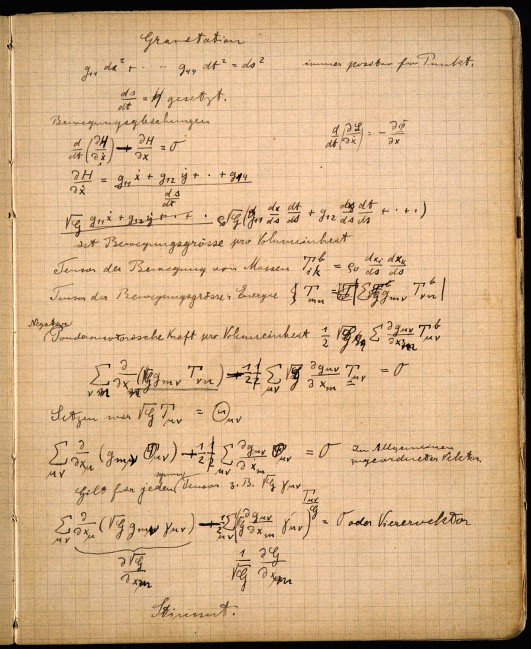 Einstein’s Zurich notebook
science
November 22, 2015
Epic British Invasion of Abyssinia, 1868
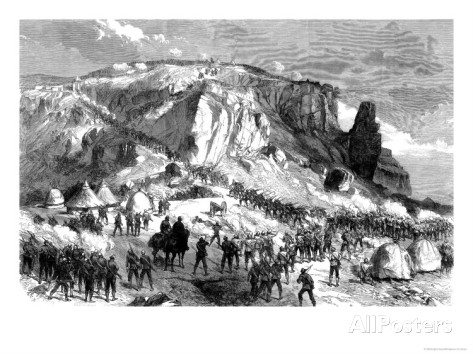
I am rereading one of my favourite chapters from Alan Moorehead’s the Blue Nile, his second book about the opening up of Africa to European explorers in the 18th and 19th centuries. The final part is the epic, reluctant British invasion of Abyssinia in 1868. (Abyssinia corresponds to modern-day Ethiopia). The episode makes the Alps crossings of Hannibal/Charlemagne/Bonaparte seem like an amble to the corner store.
Moorehead sets the tone well: “There has never been in modern times a colonial campaign quite like the British expedition to Ethiopia in 1868. It proceeds from first to last with the decorum and heavy inevitability of a Victorian state banquet, complete with ponderous speeches at the end. And yet it was a fearsome undertaking; for hundreds of years the country had never been invaded, and the savage nature of the terrain alone was enough to promote failure.”
The background (very briskly): paranoid, megalomaniacal Abyssinian King Theodore II had, after a series of comical diplomatic misunderstandings, imprisoned the British consul and a handful of unfortunate random Europeans who happened to be standing nearby him. By all accounts, Theodore was one of the most debauched, brutal and emotionally unstable tyrants “to ever swing a sceptre.” The Europeans had languished there for almost 4 years, with Theodore alternately ignoring them, torturing them, fawning all over them, and making them listen to him rant for hours about how lazy, stupid and ungrateful his own subjects were. The British Government, after patiently trying dipolomatic channels, reluctantly decided that military force was necessary to rescue them. And, in typical British fashion, they decided that if the job was worth doing it was worth doing properly.
First, marvel at what they brought with them:
[F]orty-four trained elephants were sent from India to carry the heavy guns on the march… A railway, complete with locomotives and some twenty miles of track, was to be laid across the coastal plain, and at the landing place large piers, lighthouses and warehouses were to be established. … a telegraph line several hundred miles in length… three hospital ships were to be equipped with Keith’s ice-making machines, and among their stock of medicines were 250 dozen bottles of port wine for each vessel. Then there was the question of the Maria Theresa dollars, the only general currency in Ethiopia. Not any dollar would do; only the 1780 mintin that Baker described as showing ‘a profusion of bust’ in the empress’s image was acceptable, and a search of the banks and money-lenders in Marseilles, Cairo and Vienna revealed that not enough were available. A contract therefore had to be signed with the imperial mint in Vienna for a new issue of 500,000. … From Calcutta and Bombay, from
Liverpool and London, sailing ships and paddle-steamers, vessels that were a combination of steam and sail, converged upon the Red Sea at their appointed teams. Half a million pounds was spent in hiring these ships and they carried on board every possible contrivance to set up a new temporary civilisation in the wilderness.
I should also mention the 13,000 soldiers, 26,000 camp followers and over 40,000 animals. Don’t be mistaken: all this kit wasn’t for fighting Theodore. Theodore’s army was exactly what you might imagine an African army of the mid-19th century to be: a ragtag horde of around nine-thousand tribesmen armed only with spears. So why did the British need so much gear? To do battle with the colossal Abyssinian countryside.
They were now in a region of 9,000ft passes, and the tracks up the cliffs were so steep and narrow that if one animal stopped they all stopped… Tremendous thunderstorms swept the mountains almost every day, and the men were forced to march in sopping clothing with temperatures down to zero.
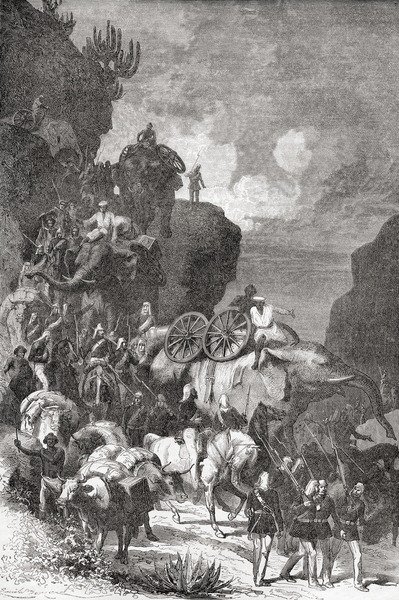
To descend for thousands of feet into one of these ravines, to wait while the sappers threw a bridge across the stream and then to climb back up to the plateau on the opposite bank - this could be the work of several days.
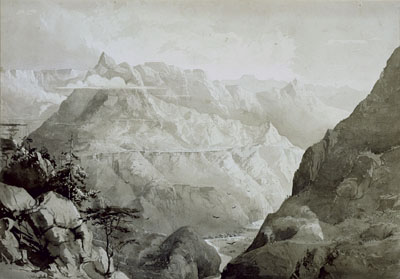
If that sounds epic then consider the Big Boss waiting at the end of their march. Again, the true enemy isn’t Theodore’s army: it’s the landscape. In this case, it’s King Theodore’s fortress village, Magdala.
Three flat-topped peaks, each about nine-thousand feet in height… an attempt would have to be made to climb the thousand foot cliffs of the fortress with the aid of scaling ladders - one of the most dangerous operations imaginable.
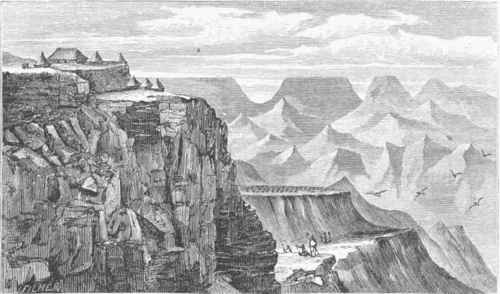
How marvelous it is to imagine the spectacle. In their comically brash uniforms they unrolled a great carpet of Britishness over mountains and through ravines and deep into Conrad’s dark heart. The engineers are laying railroads and blasting roads and sinking wells and herding elephants up steep ravines. The officers have brought their wives and dine on pheasant in their tents each night. British civilisation advances inch-by-inch into the monumental, unmapped interior of Africa[^1]. Inch-by-inch they lug their tubas and bottles of port deeper into a cruel, anarchic land of tribal warfare and marauding Arab slavers, toward a clifftop confrontation with a mad tyrant who routinely goes on weeklong drunken debauches, butchering random subjects before locking himself in a church all night to pray for forgiveness.
Then, only 5 months after the first ships arrived, they were gone. Having rescued the hostages and razed Magdala, the British methodically rolled up their carpet back to the coast, loaded everything onto boats and left. Lock and stock: they even took their railroad tracks with them.
And, yes, they really did bring a brass band.
[^1] The reader may be surprised that as late as 1875 a great deal of Africa was (to the West) still a vast blank space on the map. In particular, the source of the Nile remained one of the world’s great mysteries and had been since Herodotus first attempted to ascend the river in 460 B.C. Many explorers from many civilisations over many centuries had failed to penetrate the secret. It was through the eye-watering sufferings endured by (mostly British) explorers (Livingstone, Burton, Speke, Stanley) that the mystery was finally solved and the heart of Africa pencilled in. Their story is terrific and compellingly told in Alan Moorehead’s the White Nile (1960).
history
November 15, 2015
Twenty-five a day plus expenses
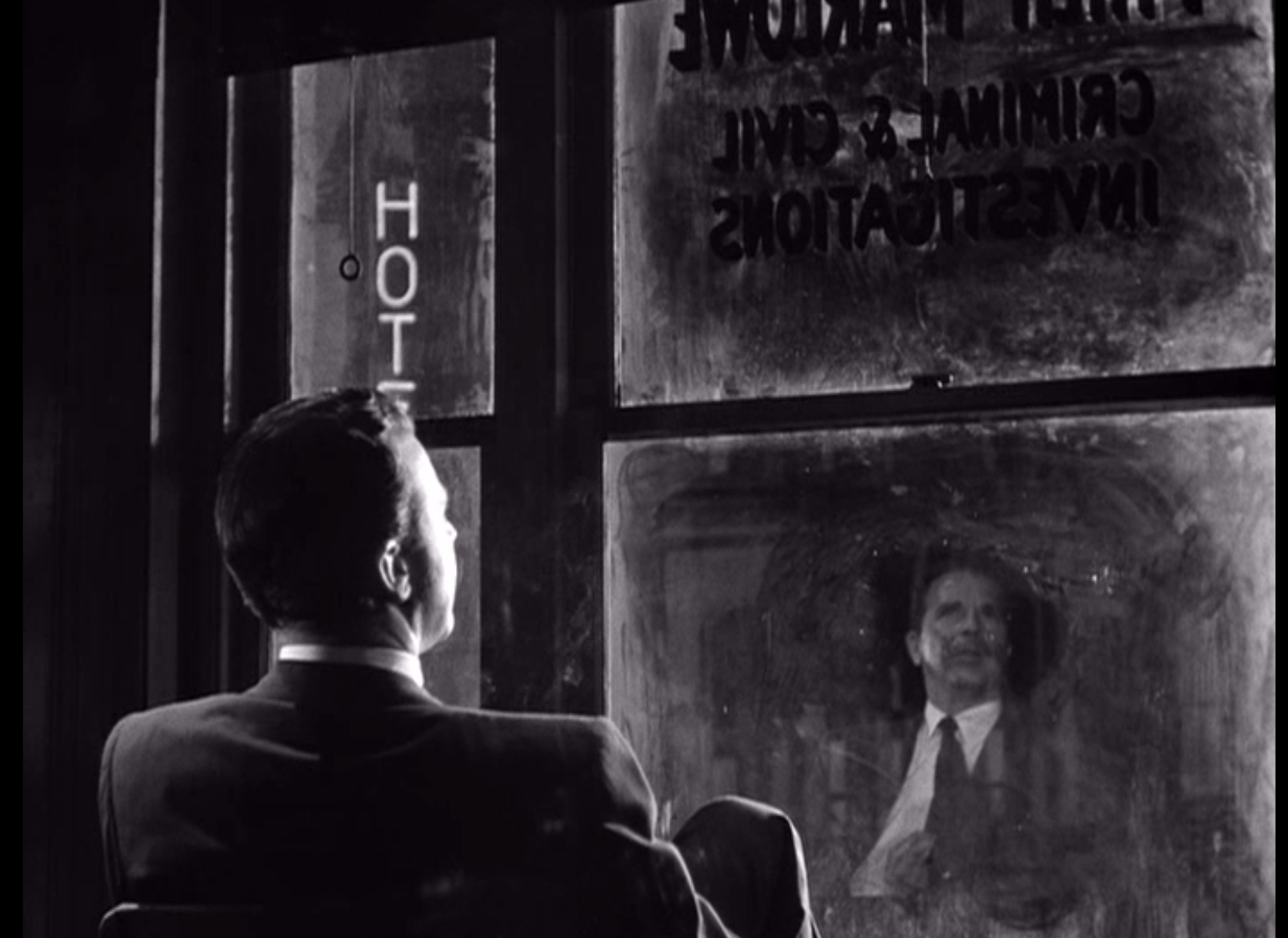
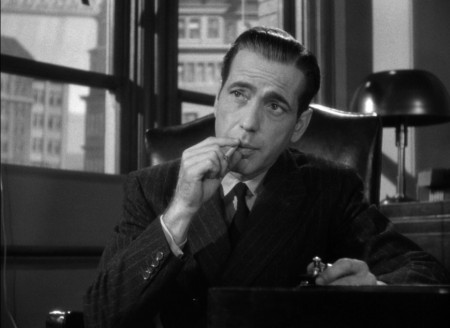
Philip Marlowe’s office, over the years:
The Big Sleep (1939):
A rust-red carpet, not very young, five green filing cases, three of them full of California climate, an advertising calendar showing the Quints rolling around on a sky-blue floor, in pink dresses, with seal-brown hair and sharp black eyes as large as mammoth prunes. There were three near-walnut chairs, the usual desk with the usual blotter, pen set, ashtray and telephone, and the usual squeaky swivel chair behind it.
The High Window (1942):
Three hard chairs and a swivel chair, a flat desk with a glass top, five green filing cabinets, three of them full of nothing, a calendar, and a framed license bond on the wall, a washbowl in a stained wooden cupboard, a hatrack, a carpet that was just something on the floor, and two open windows with net curtains that puckered in and out like the lips of a toothless old man sleeping. The same stuff I had last year, and the year before that. Not beautiful, not gay, but better than a tent on the beach.
The Little Sister (1948):
I went up to the office and unlocked the door and sniffed in the twice-breathed air and the smell of dust. I opened a window and inhaled the fry cook smell from the coffee shop next door. I sat down at my desk and felt the grit on it with my fingertips. I filled a pipe and lit it and leaned back and looked around.
‘Hello,’ I said.
I was just talking to the office equipment, the three green filing cases, the threadbare piece of carpet, the customers’ chair across from me, and the light fixture in the ceiling with three dead moths in it that had been there for at least six months. I was talking to the pebbled glass panel and the grimy woodwork and the pen set on the desk and the tired, tired telephone.
…
The pebbled glass door panel is lettered in flaked black paint: ‘Philip Marlowe … Investigations’. It is a reasonably shabby door at the end of a reasonably shabby corridor in the sort of building that was new about the year the all-tile bathroom became the basis of civilization. The door is locked, but next to it is another door with the same legend which is not locked. Come on in — there’s nobody in here but me and a big bluebottle fly.
Philip Marlowe, the greatest detective of the pulp (or any) era of crime fiction, because he is both the saddest and the funniest. Because we know the most about his life, though there is very little to know. Because he is the most gallant and uncompromising of his principles, and yet rude, disillusioned, alcoholic and down-at-heel. Because he is well aware that his life is empty, pitiful and without any hope of happiness, and yet his black humour makes it all seem so much fun.
Does Marlowe actually get paid in any of his books?
Aside: Chandler would be upset to hear me call his novels “pulp.” He had genuine literary ambitions and was bitter that the establishment disregarded his work as mere crime fiction. (Bernard V. Higgins comes to mind). But isn’t it so often wonderful when a talented author allows themselves to write genre fiction. Pynchon’s Chums of Chance in Against the Day come to mind. Kurt Vonnegut’s Kilgore Trout. It’s sad that so few quote-unquote serious authors will embrace the highlowbrow. What would a choose-your-own-adventure by Don DeLillo be like? What about a space opera by David Foster Wallace? If Nicholson Baker ever published a Mills & Boon I would pre-order the hardcover.
(Can we blame the false idols of Modernism for this? If we’re being fair then probably not. But let’s do it anyway: Modernism has a lot of tedious, pretentious fiction that it should be made to answer for. I’d like to see it dragged from its Arcadian picnic rug and gang-beaten beneath a willow tree by gangsters and aliens).
literature
 or dinosaurs